Cherbourg and the replisome
What two submarines under construction have to do with a strand of DNA.

You enter Cherbourg from above. The chantier hall is an industrial cathedral where two nuclear attack submarines sit side by side, dry-docked. Tourville (S637), almost finished, with the reactor section opened up and crews cabling the upper hull. De Grasse (S638), at the back, still showing all its ribbing.
Between them hangs an articulated, swinging structure from the ceiling of the hall, used to encase the reactor housing watertight at the moment of installation. It moves from one submarine to the other depending on which one has the reactor turn.
We had a guide: a former submarine captain who had spent years underwater inside things like the ones we had below us. He explained the flow. Hundreds of workers are on both hulls at the same time and move between them: if an operation gets blocked on Tourville, the same crew shifts to De Grasse while it waits. From the walkway you can also see the warehouse — parts arrive, are received, inspected, picked up and routed to their assembly point.
I stayed quiet for a long while watching it. The resemblance to a living cell was hard to ignore.
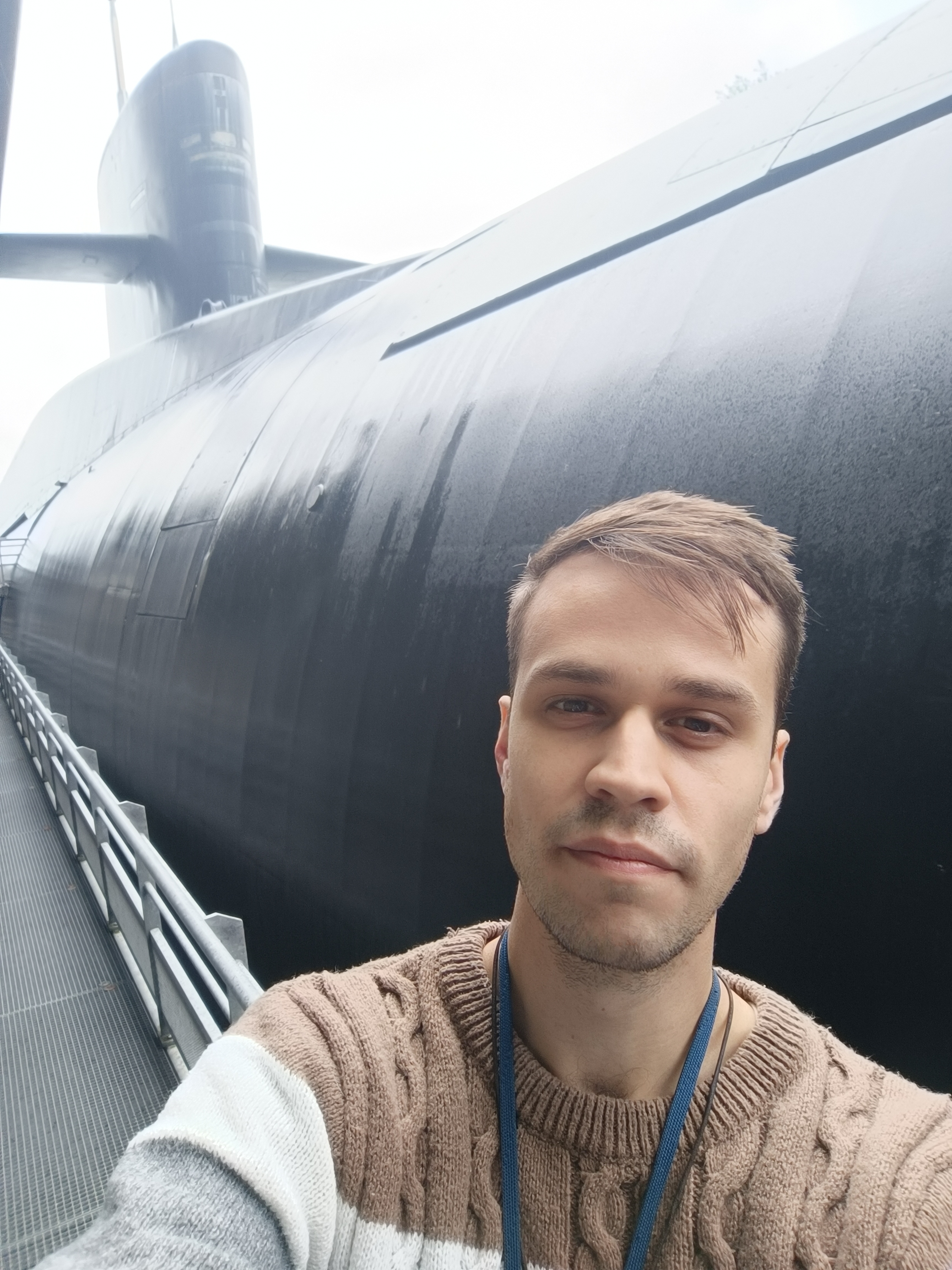
The first homothety: in time
The functional reason for building two submarines at once is practical. Tolerances on an SSN are measured in tenths of a millimetre: a hull that has to hold up two hundred metres deep has no slack. Having submarine N+1 being assembled next to N lets the team use the second one as a physical reference in real time. If a part doesn’t fit on De Grasse but did fit on Tourville, there’s a place to look in order to understand why. If at some point you need to cannibalise a part to keep the chain moving, it’s right next door.
Each submarine is a copy of the previous one with accumulated improvements. The one ahead acts as a living template for the one behind. That’s the first homothety: in time. A submarine in an advanced phase guides the next one in the same facility.
The moment the captain explained it that way, I thought about DNA replication. The parallel is hard to let go of once you see it.
The replisome
When a cell divides, each strand of its DNA has to be duplicated. The basic trick is that the double helix opens up and each of the two original strands serves as a template to build its complement. The molecular machine that does this is called the replisome: a complex of several proteins that advances along the original strand copying it, with built-in checking and error-correction mechanisms. If a base is laid wrong, there’s a protein that backs up and corrects it before moving on.
The trick works because there are two things:
- A template that determines what gets copied.
- A verification mechanism that corrects deviations.
Two strands of DNA come out where there was one. It’s one of the most conserved processes in life — the details change from prokaryotes to eukaryotes, but the idea has been the same for about four billion years.
The second homothety: in scale
What the team at the Cherbourg shipyard does is the same thing, but with parts that weigh tonnes and humans acting as the replisome. They have a living template: the submarine that’s ahead. They have a verification mechanism: the tolerance checks between the two hulls. They have error repair: if a part doesn’t fit, you back up and fix it before moving on.
And there’s more. The chantier’s transport system receives components, inspects them, picks them up and routes them to their assembly point along defined paths, the same way a cell carries proteins from the ribosome to wherever they need to work. The hanging structure that swings between the two submarines to encase the reactor looks like a mitochondrion the size of a building, ready to move close to the place where energy needs to be produced. The warehouse functions as the cytoplasm. The internal routes are its cytoskeleton. The workers, proteins with specific functions who rotate between tasks depending on where the bottleneck is at that moment.
That’s the second homothety: in scale. The SSN, the most advanced thing we know how to build, is a recapitulation of life’s oldest trick.
Why it matters
What stuck with me from that day is the background figure. At the frontier of human engineering we’re still amalgams of proteins doing on a large scale what proteins do small. When you let the idea settle it spins your head a little: something your body has been doing since before you had hands, when we hand it to a thousand engineers and twenty thousand tonnes of steel, is still the same process. Template, copy, verification, transport, assembly.
As happens with any copy system with non-zero tolerance, the small accumulated variations are the raw material for evolution. Each generation of French submarine improves on the previous one: from Triomphant to Suffren, from Suffren to Barracuda. Selection here isn’t blind as in biology, the engineers pick the improvements on purpose, but the skeleton of the process is the same: copy with variation, verification, iteration over time.
Closing
I left the chantier thinking about submarines for days. More exactly, thinking about how much of what I admire technically in the world is, looked at closely, a recapitulation at a different scale of what already happens inside us without us noticing.
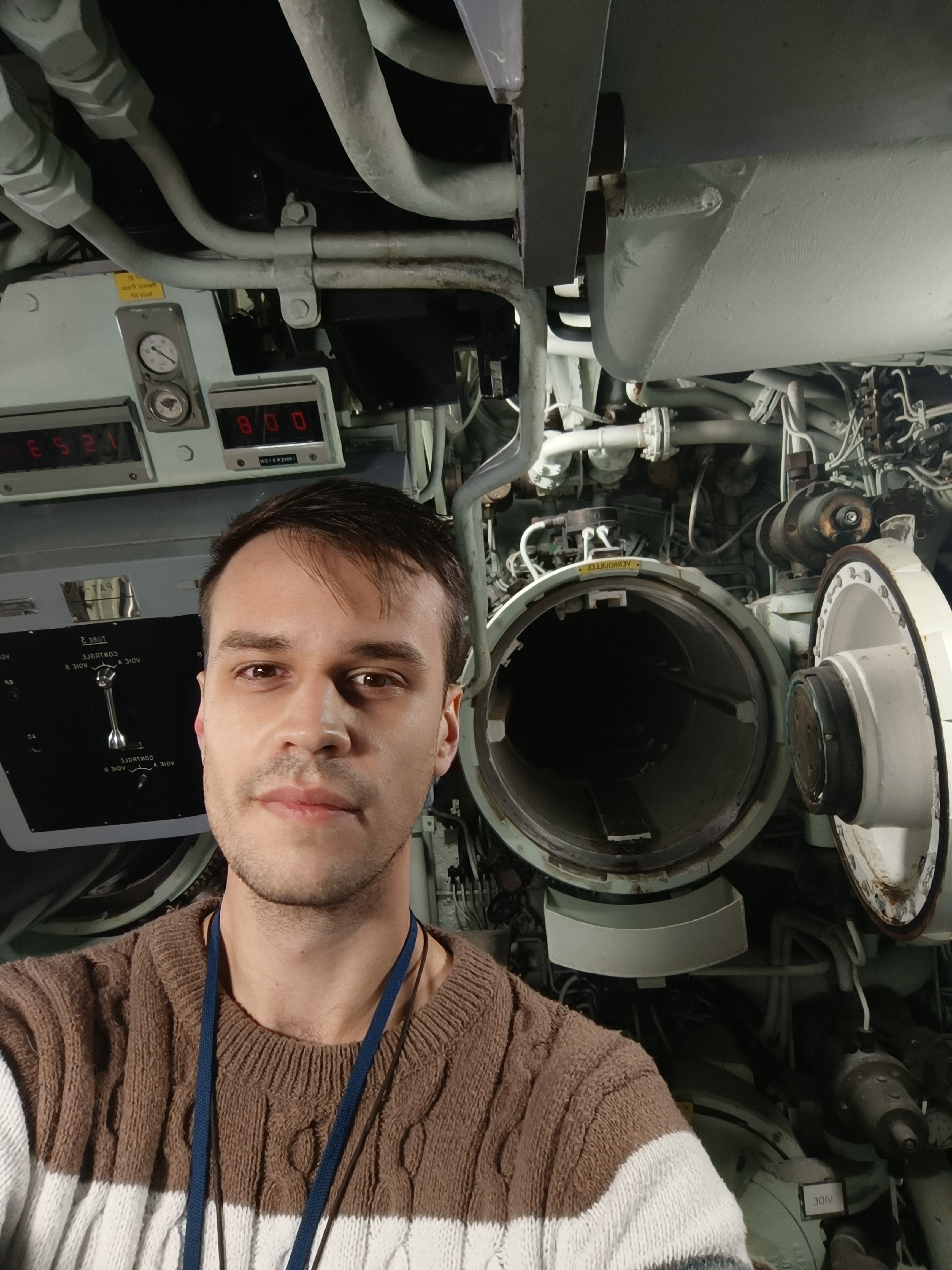
Enclosed spaces paradoxically can give a sense of freedom, security and power, especially when they hold everything needed and serve as a proxy for the real world. A submarine is one twice over: it’s a proxy for the world, and it’s a proxy for the cell that builds it.